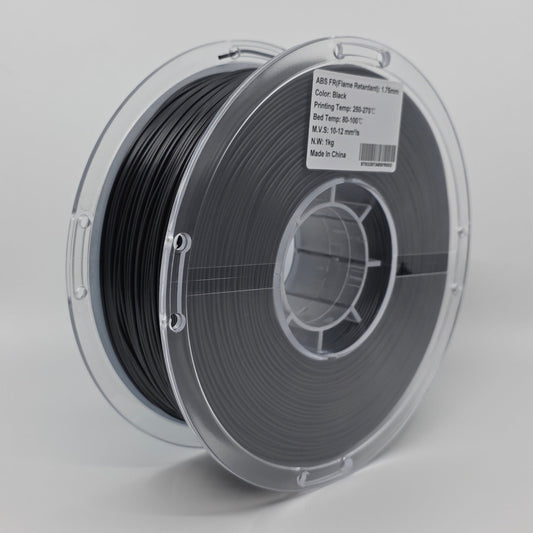
Collection: ABS Flame Retardant

ABS-FR Filament is a specialised flame-retardant engineering material designed for applications where fire safety, heat resistance and mechanical durability are critical. Combining the strength and toughness of ABS with UL 94 V-0 flame-retardant performance, ABS-FR is ideal for electrical, industrial and safety-focused components.

Read More

1 product

Unlike standard ABS, ABS-FR is formulated to help reduce flame propagation while maintaining excellent impact resistance, dimensional stability and reliable printability. This makes it well suited to demanding environments where both performance and safety requirements must be met.

Why Choose ABS-FR?

  • UL 94 V-0 flame-retardant performance
  • Excellent heat resistance and durability
  • Strong impact resistance and toughness
  • Reliable dimensional stability for engineering parts
  • Professional finish suitable for industrial applications

Common Applications

  • Electrical enclosures and housings
  • Battery packs and battery housings
  • Control panels and switchgear components
  • Automotive electronics
  • Industrial equipment and machine parts
  • Engineering prototypes requiring flame resistance

Performance Benefits

ABS-FR combines the proven strength of ABS with enhanced fire safety properties. It offers excellent mechanical performance while helping to reduce flame propagation in safety-critical environments.

Printer Compatibility

ABS-FR performs best on enclosed FDM 3D printers with a heated bed and stable chamber temperatures. Enclosures help minimise warping and improve layer adhesion for consistent results.

ABS-FR Specifications

  • Flame rating: UL 94 V-0, manufacturer rated, test documentation available on request
  • Diameter: 1.75mm, tolerance ±0.02mm
  • Spool: 1kg net
  • Nozzle temperature: 230 to 250°C
  • Bed temperature: 80 to 100°C
  • Enclosure: required
  • Hardened nozzle: not required
  • Drying: 70 to 80°C for 4 to 6 hours

Explore More Engineering Materials

Looking for alternative high-performance materials? Browse our Engineering Materials collection, ABS filament, or ABS Carbon Fibre filament for additional strength and specialised performance.

All ABS-FR filaments ship fast from Australia, with same-day processing available on most orders.

Frequently Asked Questions

What does UL94 V-0 mean for ABS-FR?

UL 94 V-0 is the highest classification in the UL 94 vertical burn test. To reach it, a material must stop burning within roughly ten seconds of the ignition source being removed, and must not drip flaming particles that ignite material below it. ABS-FR carries a manufacturer UL 94 V-0 rating, with test documentation available on request. Standard ABS carries no such rating and will keep burning once lit.

Is a 3D printed ABS-FR part UL94 V-0 compliant?

Not automatically, and this is worth understanding before you rely on it. The V-0 rating applies to the material, tested on standardised specimens at a defined thickness. A printed part behaves according to its own geometry: wall thickness, infill density, layer adhesion and print orientation all affect how it responds to flame, so a thin part at low infill will not perform like a solid test bar. Choose ABS-FR because the base material is rated, and validate any part that has to satisfy a formal compliance requirement in its finished geometry.

Does ABS-FR self-extinguish?

Yes, and that is the practical meaning of the V-0 rating. The material is formulated to stop burning once the ignition source is removed, instead of sustaining and spreading a flame the way standard ABS does. It is a genuine change in formulation, not a cosmetic difference.

What temperature does ABS-FR print at?

Nozzle 230 to 250°C, bed 80 to 100°C, printed in an enclosure with the part cooling fan off or very low. Dry it at 70 to 80°C for 4 to 6 hours if the spool has been open for a while.

Does ABS-FR need a hardened nozzle?

No. The flame-retardant additives are not abrasive, so a standard brass nozzle handles ABS-FR without unusual wear. Only our carbon fibre grades such as ABS-CFRP-CF require a hardened nozzle.

Does ABS-FR print differently from standard ABS?

No. It runs on standard ABS settings, needs the same enclosure and heated bed, and warps in the same conditions. The flame retardancy comes from the formulation rather than from anything you change in your slicer, so you can treat an existing ABS profile as the starting point.

Is ABS-FR suitable for parts near batteries and electronics?

That is exactly what it is for. Battery housings, connector blocks, control panel components and enclosures sitting near a heat source are the cases where standard ABS is the riskier choice, because it will sustain a flame if something ignites. ABS-FR gives you a rated material in those positions. It does not replace correct electrical design, clearances or fusing.