
-
PETG-CFRP-CF
Vendor:FilamentHubRegular price $29.99 AUDRegular priceUnit price perinc GSTSale price $29.99 AUD

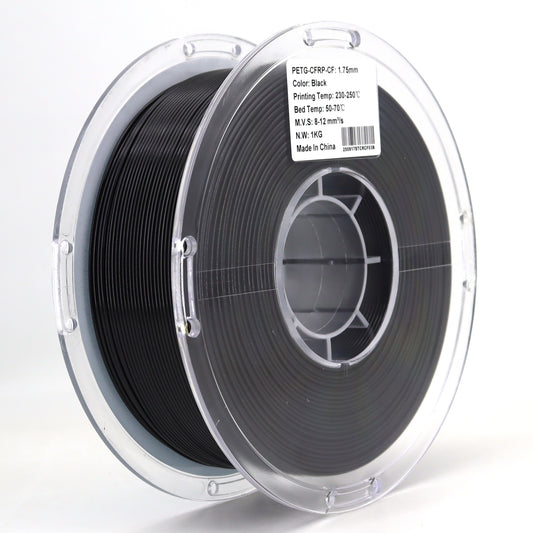
Strength and Reliability
mechanical load, holds tight dimensional tolerances, and prints without the warping issues common to other high-performance filaments. It is used across drone frames, automotive brackets, tooling jigs, structural enclosures, and any application where a standard PETG filament or ABS filament would flex or deform under stress.
Availability and Support
FilamentHub stocks PETG CF with same-day dispatch and local pickup available at Harrington Park, NSW. If you are unsure whether your hotend setup is configured for carbon-reinforced materials, contact us and we can help you get your settings dialled in before you start.
What Carbon Fibre Adds to PETG
Standard PETG is valued for its ease of printing, layer adhesion, and chemical resistance. Adding chopped carbon fibre strands to the matrix increases rigidity significantly without making the material brittle. The fibre reinforcement also reduces shrinkage during cooling, which means large-format parts hold their shape better across the full print and are less prone to corner lifting or dimensional drift.
The surface finish of PETG CF differs noticeably from standard PETG. The carbon particles produce a matte, textured appearance that reduces the visibility of layer lines, giving finished parts a more refined look without post-processing. For projects that combine aesthetic requirements with functional demands, this is a practical advantage over glossy or semi-transparent standard materials.
Durability and Comparisons
PETG CF also retains the moisture and chemical resistance of the base PETG material, making it suitable for industrial environments and applications involving exposure to oils, solvents, or humidity. For parts that face sustained UV exposure outdoors, ASA filament is the more appropriate choice. For higher-temperature or more demanding structural applications, the full engineering filament range offers further options.