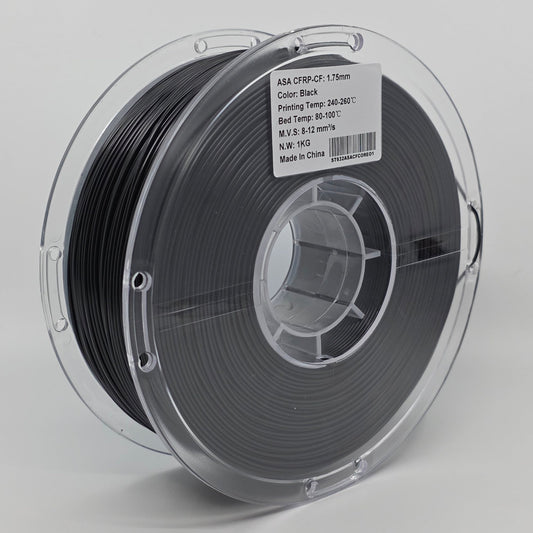
Collection: ASA Carbon Fibre Filament

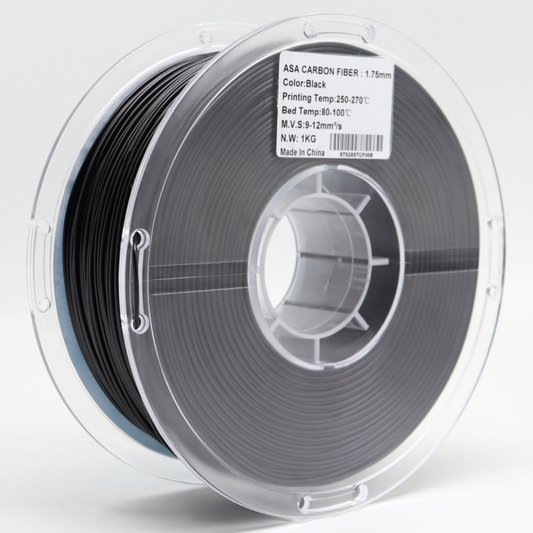
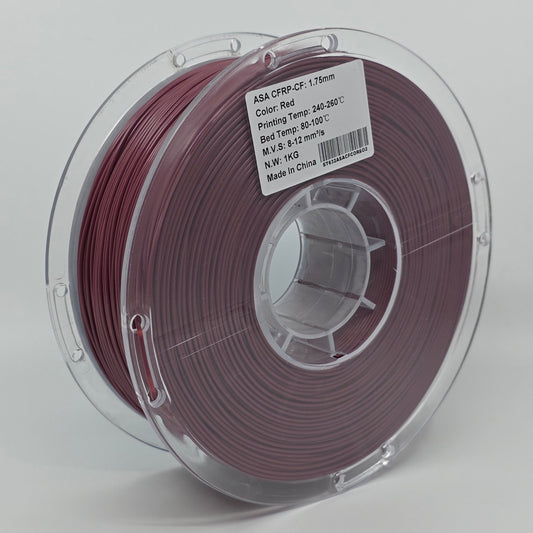
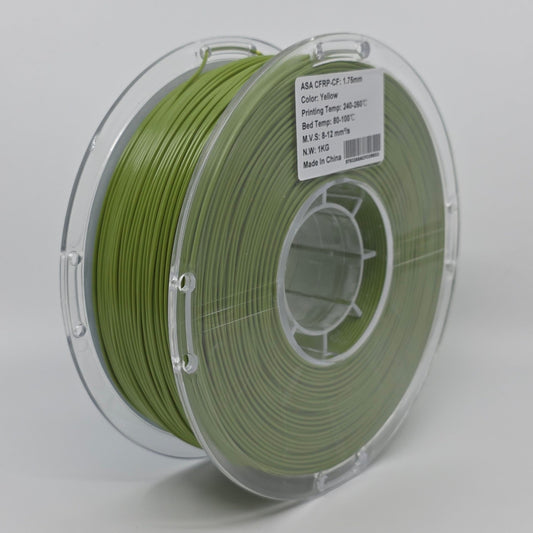
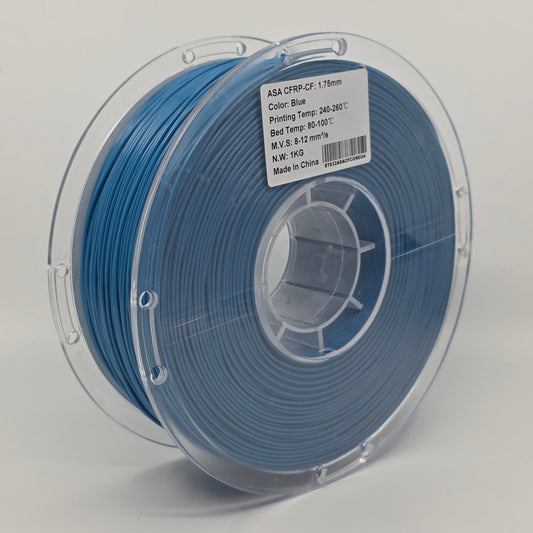
ASA Carbon Fibre filament covers two different constructions here, ASA CF and ASA-CFRP-CF, both combining ASA's weather and UV resistance with carbon fibre reinforcement for added stiffness. It requires an enclosed printer and a hardened nozzle, and we currently stock ASA CF in one colour plus ASA-CFRP-CF in four colours, Black, Red, Green and Blue, all in 1.75mm and held locally in Australia.

Read More

5 products

Two Different Carbon Fibre Constructions

These are not the same material under two names, they are built differently:

  • ASA CF: chopped carbon fibre mixed evenly throughout the ASA, the traditional approach to a CF composite
  • ASA-CFRP-CF: co-extruded, a carbon fibre reinforced core wrapped in an ASA outer layer, giving a smoother surface than a standard CF blend while keeping the same added stiffness

Both trade a little flexibility for real rigidity and dimensional stability over standard ASA. The construction just changes how that stiffness gets there and how the surface finishes.

What Prints Suit ASA CF Best?

Both constructions earn their keep on parts that need to survive outdoors and hold their shape:

  • Outdoor brackets and mounts
  • Automotive and motorsport components
  • Drone, RC and lightweight structural parts
  • Industrial fixtures and engineering prototypes

Printer Compatibility and Nozzle Wear

Both ASA CF and ASA-CFRP-CF need an enclosed printer with a heated bed to control warping, the same as standard ASA. Compatible with Bambu Lab, Prusa, Creality and other enclosed FDM systems.

A hardened steel nozzle is required for both, not optional. The carbon fibre content in either construction will wear down a standard brass nozzle quickly.

Why Add Carbon Fibre to ASA Specifically?

ASA is already the material we recommend for outdoor and UV exposed parts. Adding carbon fibre on top gives you that same weather resistance plus real stiffness, useful for outdoor brackets, mounts and structural parts that need to hold their shape under load as well as survive the sun.

Explore More Carbon Fibre Options

Looking for a different base material? PLA-CFRP-CF is the easiest to print, PETG CF adds better layer adhesion, and ABS-CFRP-CF trades UV resistance for higher heat tolerance. You can also browse the engineering filament range.

All ASA Carbon Fibre filament ships fast from our Sydney warehouse, with quick processing and reliable Australia-wide delivery.

Frequently Asked Questions

What is the difference between ASA CF and ASA-CFRP-CF?

They are two different constructions, not one material under two names. ASA CF mixes chopped carbon fibre evenly through the ASA, which is the traditional approach to a CF composite. ASA-CFRP-CF is co-extruded: a carbon fibre reinforced core wrapped in an ASA outer layer, which gives a smoother surface than a standard blend while adding the same stiffness. Both need an enclosure and a hardened nozzle. Choose ASA-CFRP-CF when surface finish matters, and ASA CF if you want the conventional blend.

Does adding carbon fibre reduce ASA's UV resistance?

No. ASA's weather resistance comes from the polymer itself, not from a coating or additive that carbon fibre could dilute, so a CF grade keeps it. In the co-extruded ASA-CFRP-CF the surface facing the sun is ASA anyway, because the fibre sits in the core. This is the whole reason to reach for ASA CF instead of ABS CF on anything that lives outdoors.

Is ASA CF stiffer than standard ASA?

Yes, noticeably. Both constructions add real rigidity and dimensional stability over standard ASA, with reduced shrinkage. The trade is a little flexibility: a CF grade resists bending where standard ASA would flex, which is what you want in a bracket and not what you want in a part that needs to give.

Does ASA CF need a hardened nozzle?

Yes, for both constructions, and it is not optional. Carbon fibre is abrasive and will wear a standard brass nozzle down quickly, whether the fibre is blended through the filament or concentrated in a core. Fit a hardened steel nozzle before printing either one.

What temperature does ASA CF print at?

Nozzle 250 to 270°C, bed 80 to 100°C, printed in an enclosure. Dry at 70 to 80°C for 4 to 6 hours if the spool has been open for a while. Note that it runs hotter than ABS CF at 240 to 260°C, so do not reuse a carbon fibre ABS profile unchanged.

Is ASA CF or ABS CF better for outdoor parts?

ASA CF, whenever the part lives outdoors. The two are close on stiffness and the deciding factor is UV exposure: ASA holds its colour and surface finish where ABS yellows and chalks in sunlight. Keep ABS CF for indoor, under-bonnet and workshop parts, and use ASA CF for anything mounted outside.

Is ASA CF suitable for drone and RC parts?

Yes, and it is one of the better uses for it. Drone and RC components need to stay rigid in thin sections, and they usually live outdoors, which is exactly where carbon fibre reinforcement and ASA's UV stability pay off together. Arms, brackets, mounts and structural parts all suit it.