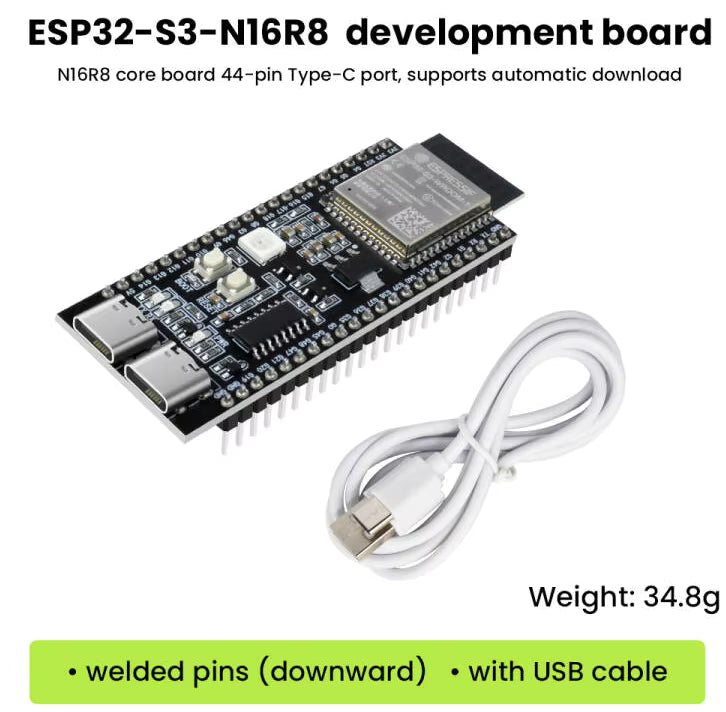
The ESP32-S3-N16R8 is a dual-core WiFi and Bluetooth development board built around Espressif's ESP32-S3, with 16MB of flash and 8MB of PSRAM on a 44-pin core board. Headers come pre-soldered facing down, and a USB cable is included, so it is ready for a breadboard out of the packet.
What N16R8 Actually Means
The suffix is the memory configuration, and it is the main thing separating one ESP32-S3 board from another. N16 is 16MB of flash, which is where your program and any web assets live. R8 is 8MB of PSRAM, extra RAM the chip can use for buffers. That combination is the high-spec end of the range, and it is what you want if you are driving a display, buffering camera frames, serving a web interface, or running anything that outgrows the chip's internal memory. Cheaper boards ship as N4 or N8R2 and run out of room quickly on those jobs.
What Makers Build With It
This is the board behind a lot of the enclosures and brackets people print:
-
Printer and drybox monitoring, reading temperature and humidity and reporting over WiFi
-
Filament runout and jam sensors wired into a printer
-
Addressable LED control for chamber lighting and status displays
-
Home automation nodes running ESPHome or Tasmota
-
Small displays and camera projects, which is where the 8MB of PSRAM earns its place
Two Type-C Ports and Automatic Download
The board carries two USB Type-C ports rather than one, and supports automatic download. In practice that means you plug in, hit upload, and the board resets itself into bootloader mode without you holding BOOT and tapping RESET. If you have used an older ESP board and remembered the button dance, this is the part you will notice first.
Specifications
-
Chip: Espressif ESP32-S3, dual-core Xtensa LX7 at up to 240MHz
-
Flash: 16MB
-
PSRAM: 8MB
-
WiFi: 802.11 b/g/n, 2.4GHz
-
Bluetooth: Bluetooth 5.0 and Bluetooth Low Energy
-
Headers: 44-pin, pre-soldered facing down
-
GPIO: up to 38 usable pins on the ESP32-S3
-
USB: two Type-C ports, automatic download supported
-
Input voltage: 3.0V to 5V
-
Onboard: RGB LED, Boot and Reset buttons
-
Weight: 34.8g
-
Included: USB cable
Getting Started
The board works with the usual ESP32 toolchains: Arduino IDE, ESP-IDF and PlatformIO. Select an ESP32-S3 board profile, and enable PSRAM in the board settings if your sketch needs it, since it is off by default in some profiles and is a common reason projects report less memory than expected.
Printing a case or bracket for it? PETG handles warmth near electronics better than PLA does. If you are printing trays, bins or assembly jigs that hold bare boards, our ESD filament is static-dissipative and made for exactly that job. A set of antistatic ESD tweezers is the safe way to move small parts around while you work. Browse the rest of our electronics and modules. Ships fast from our Sydney warehouse with Australia-wide delivery.